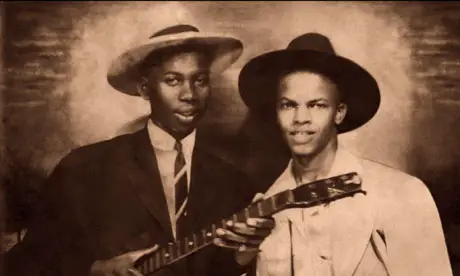





Can you learn blues on acoustic?
Delta Style Blues - The Holy Grail For The Blues Feeling
Just one step up from the field holler & work songs, basic bottleneck delta blues style is like a tortuous cry from the soul.
Maybe this style developed first, as it reduced the need to use many chords. In fact, when many people refer to 'the blues', the Mississippi Delta style is what they really mean.
Often, the guitars were tuned down - to drop G, drop D and sometimes drop C. For sure, it produces a plaintive sound when done properly, and some exponents such as Johnny Shines, Muddy Waters and Robert Johnson used this way of playing to great effect.
It may also be that a a tuned down guitar was easier to keep in tune in the humid swelter of the Mississippi in the deep South, where this blues music was born in a typical call and response pattern.
One famous delta blues artist was anything but delicate in his technique, but the power and emotion of Son House ensures him a place at the head of the blues table when listing the masters we need to study when wanting to learn how to play blues, even though his thrashing style was a far cry from the later twelve bar blues and more complex chord progressions.
The search for technical complexity can become the Holy Grail for guitarists, but it's a mistake.
Few guitarists can match the power of the old blues masters, simply because their basic techniques are not solid enough to develop a solid authentic groove, which is the basis of all jazz, rhythm and blues, not to mention rock and roll.
There are no short cuts to the power of the blues. Listen to the walking bass lines of guitarists like Gary Davis, Big Bill Broonzy and the blue notes in any shuffle from Lightnin Hopkins.
Hopkins could play just one bass note and send a shiver up your spine. It isn't the complex technique that makes the blues, but the feeling and power behind it.
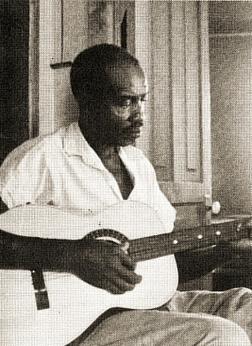
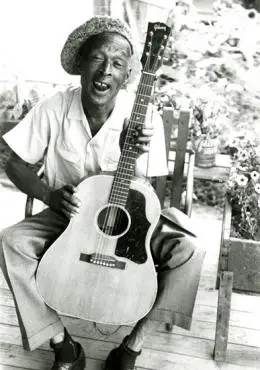

Floyd council Pink Anderson Blind Boy Fuller Lightnin' Hopkins
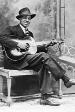


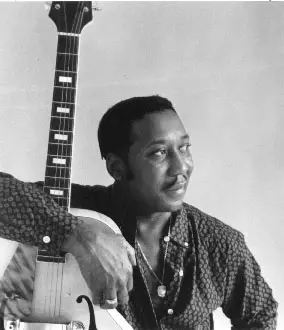

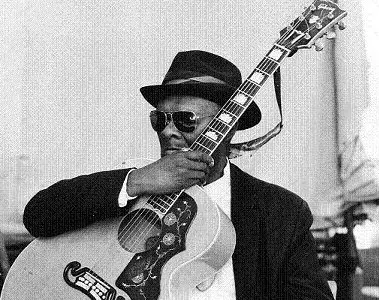
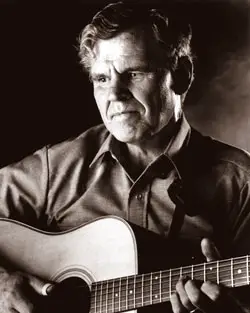

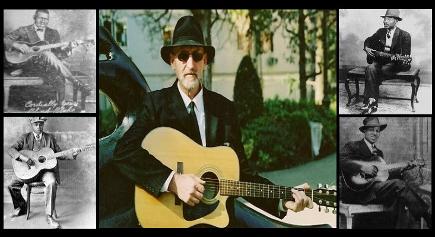
The Roots Of The Blues - Beginning Blues Guitar
 Learning blues guitar in today's world is a curious thing to go for.
Even the least well off in Western countries are so much richer than the early blues legends who first invented the wonderful music that was the corner stone of all the various musical styles of our times.
Even making use of the best blues guitar tabs, it's difficult for students to identify with the authentic spirit.
The first beat quite obviously was handed down from the people's roots in Africa, but modern African music is much more rich in rhythmic differences and more complex, so how did this happen?
It's known that early 'guitars' were basic instruments with a single string, cobbled together from a large wooden cigar box, or similar box.
It wasn't practically feasible to produce musical sounds of a very intricate form, and possibly made a short lived 'damped sound', with small difference in tune quality.
Also, for a lengthy time in southern America, traditional drums were outlawed, as were other cultural things that enhanced the inner strength of the black people and instilled principles of self determination or freedom from slavery.
Maybe the hypnotic feel of the primordial blues guitar chords were intended to be drum like, possibly explaining why the single string thumb strike style of plucking was among the first to be used.
In that technique of playing guitar, the rhythmic pattern was basically simpler and the thumb picking stroke was made to sound like a drum's beat.
In those tough decades, a dedicated guitarist would pluck a monotonous bass pattern which frequently was at the same timing as a beating heart. This made sure that the beat has an emotional contact and it wasn't that important for the music to be analyzed, or be musically over structured.
Yet another possibility is in relation to the jobs that negro laborers were forced to apply themselves to. Most variations of tough work implies rhythmic repeated actions, such as hammering, cutting down cereal grass, digging turf with a hoe, hitting with a hammer or levering over steel rails for train tracks.
You can find examples of the work in restored film archives of the time, where a line of workers with strong iron bars holler a repeating work song and synchronize their work motion such that the massive steel rail is eased over a short distance at the finish of a line of verse or perhaps the chorus.
More often than not the work song was split up and an answer sung by designated parts of the work crew. This successful application of question and answer was utilized in many blues songs when sung by a couple of singers, and was a mainstay in church blues music.
Even though it's a fact that modern day music has been developed with complicated musical patterns and interesting rhythmic variations, the fundamental rhythms are detected.
The elemental guitar boogie is unmistakable in a huge number of rock classics in the past 50 years and the style extended the traditional blues guitar chords. The more varied syncopation of ragtime guitar became the foundation of the first attempts at jazz.
From Street Singer To Acoustic Blues Guitar Lessons Guru
Jim Bruce was voted N°2 Top Internet Guitar Instructor 2013 after making a living playing blues guitar on the streets.
When first starting to search for those ideal lessons acoustic for guitar, many people used to go to the great 'G', and 'Google it'.
More and more searches for everything imaginable are made on Youtube, as a matter of fact, it's the 2nd most favorite search engine after Google itself.
Like Google, the number of items returned for a search such as 'blues lessons' is formidable - how to determine the instruction that's best for you and how to play acoustic guitar in the authentic style?
Youtube guitar lessons feature all manner of styles and teaching levels, both paid and for free. Blues guitar tabs are the basis of the best guitar lessons.
It doesn't have to be incredibly complex at all, with just elementary notation indicating finger movements and blues guitar chords. Some blues tabs go into too much detail, trying to capture the feel and ambiance of authentic blues playing, which just isn't possible!
This points us to the 2nd characteristic of good blues lessons - the teacher must be able to play acoustic music very well (and the tablature should precisely represent what he is playing.)
Guitar tablature itself isn't enough to translate that delicate pause, or the thumb strike that is a little off-beat when needed to complement the words.
Sure, the tab can show that a single thumb stroke should be damped with the palm of the hand, but can't indicate that this damping movement itself isn't continuous, but varies in sound as the force of the palm on the strings is continually being changed according to the flow of the song.
Take your time when looking for any instruction, of any kind.
The Chinese have a saying 'a year or 2 spent doing nothing but locating the right instructor is very well spent'. This is a good observation. You don't need to take a year for your search, but choose carefully and ignore the hype.
Don't expect to improve in 2 weeks, take it easy, don't beat yourself up and above all, enjoy the music and the travel.
THE VITAL FEATURES OF GREAT VIDEO GUITAR LESSONS
A search on the internet for guitar instruction in video format can turn out to be a daunting activity, particularly for the fledgling student with little experience.
What are the best features of the most effective packages on offer? As you might imagine, we can identify common components that might help us choose the right tuition.
Tuition should be Easy To Follow
Although it almost goes without saying, any tutorials acoustic for whatever subject needs to flow in a logical way and be simple to take in.
First steps need to be clearly described and grow into further lessons. Musical theory is important, but a student guitar player is basically impatient to start learning - he would like to play!
This must be the first step, presenting the basic things that can be put into practice straight away. When all said and done, a thorough understanding of the first concepts will bring huge advantages later on in the instruction.
Musical Notation versus Tablature
Traditionally, guitarists in the classical style learned to read musical notation and followed the written notes when performing or composing new music.
Inevitably, this means a progress that is often perceived as too slow in today's fast-moving world. During the 30s, blues guitar master Stephan Grossman and others created a method of guitar tablature that represented the frets and strings of the guitar neck.
This abbreviated 'musical' notation was quickly assimilated and is an effective tool for learning blues guitar, for example.
A grid of six strings is numbered from the bottom bass string (1) to the top E string (6) and a number written on a string shows which fret finger should be placed above. A straight line at the side of the number denotes that the thumb or finger is employed.
For comprehensive online acoustic learning, platforms like Truefire offer extensive acoustic lessons and fingerstyle guitar tutorials. These structured courses ensure students can efficiently progress from beginner to advanced levels. The focus on acoustic fingerstyle techniques is especially beneficial for those interested in mastering this intricate style.
There are many variations for this theme, but we can identify important features of this vital visual aid to guitar tuition. The student should be made aware right at the beginning what the purpose of that instruction may be.
A close up of both hands are invaluable, and would be best shown separately. Blues guitar chords and tab may be overlaid on the screen, so that students can follow the finger movements at the same time.
More Desirable Attributes Of Acoustic Blues Guitar Tuition
When being taught a song, it's good to have the words at hand and a short discussion covering singing whilst playing. This might seem obvious, but it's quite tricky for a new student to do both together!
Some people, notably Eric Clapton among them, seems to want to BE Robert Johnson. It's a bit strange, but I completely understand the infatuation that consumes some folk when discussing Johnson, his work and his place in the scheme of things.
For me, it's not a fat lot of good trying to be someone else, but agree that it's fantastic fun trying to work out how he played.
Singing and Playing
Of course, Johnson's emotional intensity and his prowess on acoustic guitar was formidable and has inspired countless musicians over the last 90 years or so. For one thing, it seemed as though he could deliver his lyrics asynchronously to the guitar patterns.
Well, normally a guitarist plays something quite complex in between the lines of verse, creates a space or beat and then sings over the musical state he created. It's very common and I do it myself all the time.
Some fans have analyzed the old 78s and found that they were speeded up quite substantially, so we actually hear Johnson singing at a higher pitch and faster than he actually did!
Johnson's Repertoire
Looking at his output of 26 sides, they can be grouped into various keys and styles, notably open G, dropped D and normal tuning. All his songs in any particular key were very much the same, which is the same for all of us.
In those days, it was important to have a broad variety of songs in your repertoire, so that the audience wouldn't get bored and you could play something for everyone - no doubt requests were often made for popular or traditional songs.
Was Robert Johnson Original?
I'd have to say No. Many of his songs were basically traditional and re-worked by RJ. Intense works like Crossroads were another reincarnation of Walkin' Blues, which was performed by Muddy Waters and Son House before Johnson's recording. Come On In My Kitchen, another song on open G was a disguised version of 'Sitting On Top Of The World', a Jug Band favorite.
His songs in the key of A did produce some interesting riffs not found in other blues men's work, so in that sense, he was original.
How Did He Create His Guitar Sounds?
Possible the two best guides would be Son House and Johnny Shines. House's thrashing right hand picking style was very different from Johnson's intense delicacy, but many of the riffs are the same.
Search for 'Johnny Shines Sweet Chicago' on Youtube and you'll find a great old video showing Shine's hands in close up - this is probably just how Johnson played it.